


Introduction
Starting an online business in Nepal no longer means you need to build a complicated website before making your first sale.
A home-based clothing seller can start with Facebook Marketplace. A retailer can list products on Daraz. Someone selling second-hand electronics can use Hamrobazar. And a business that wants its own brand, domain name, and online store can build a website with WooCommerce or Shopify.
The challenge is choosing the right platform.
Each option works differently. WooCommerce and Shopify help you build an independent eCommerce website, while Daraz, Hamrobazar, and Facebook Marketplace give you access to an existing platform and audience.
That distinction matters.
If your goal is simply to test whether people will buy your products, a marketplace may be enough. If you’re building a long-term brand and want control over your website, product pages, customer experience, and marketing, an independent eCommerce store is usually a stronger foundation.
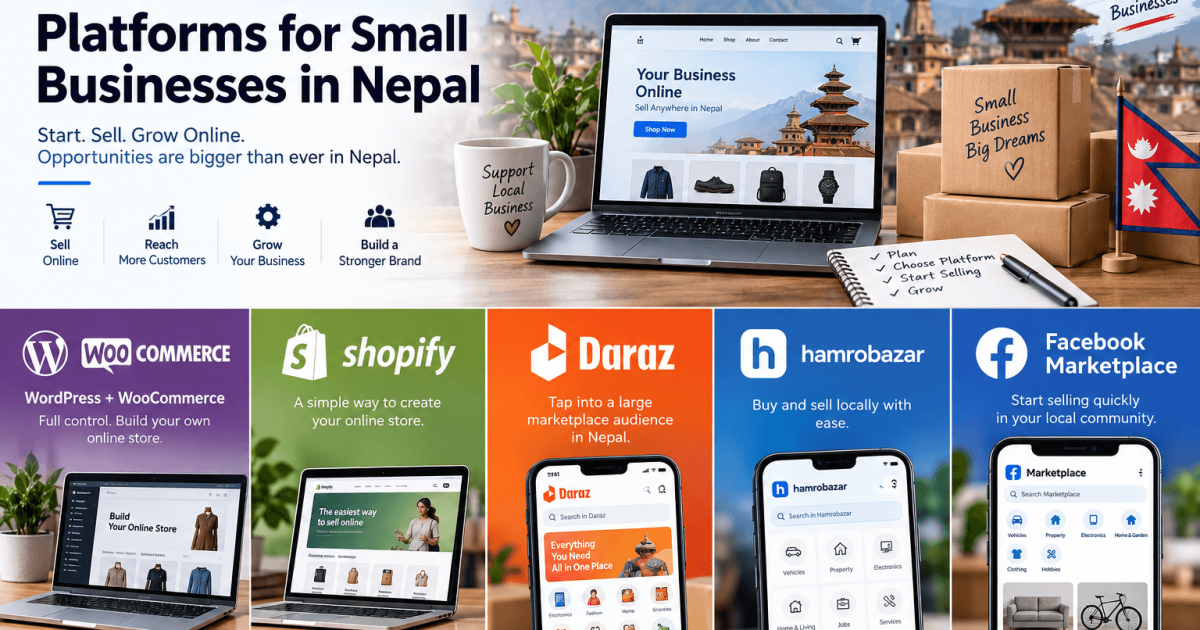
In this guide, we’ll compare five popular options for ecommerce in Nepal:
- WordPress + WooCommerce
- Shopify
- Daraz Nepal
- Hamrobazar
- Facebook Marketplace
We’ll look at what each platform does, where it works well, its limitations, and which type of Nepali business may benefit from it.
Quick Comparison: eCommerce Platforms for Businesses in Nepal
| Platform | Best Suited For | Own Website? | Setup Level | Main Strength |
|---|---|---|---|---|
| WordPress + WooCommerce | Businesses building a long-term online brand | Yes | Moderate | High control and customization |
| Shopify | Businesses wanting a hosted online store | Yes | Easy–Moderate | Simplified store management |
| Daraz Nepal | Retail businesses seeking marketplace customers | No | Easy–Moderate | Existing shopping audience |
| Hamrobazar | Local, niche, used, and classified products | No | Easy | Direct buyer enquiries |
| Facebook Marketplace | Beginners and local sellers | No | Very Easy | Low barrier to entry |
There isn’t one platform that is right for every business.
The right choice depends on your budget, technical experience, products, payment requirements, delivery process, marketing strategy, and long-term goals.
1. WordPress + WooCommerce
For businesses that want to build their own eCommerce website, WordPress with WooCommerce is one of the most flexible options to consider.
WooCommerce is an open-source eCommerce platform built for WordPress. The core WooCommerce plugin is free and allows businesses to create product pages, manage orders, configure shipping and payments, offer discounts, and customize their storefront.
Unlike selling entirely through a marketplace, WooCommerce allows your business to operate from its own domain, such as:
yourstore.com.np
That means your website becomes the main digital property for your business rather than relying completely on another company’s platform.
Why WooCommerce Makes Sense for eCommerce in Nepal
The biggest advantage of WooCommerce is control.
Because the platform is open source, store owners can customize the design, checkout experience, features, hosting environment, and integrations according to their requirements. WooCommerce also supports extensions for areas such as payments, marketing, subscriptions, shipping, analytics, and product management.
This can be particularly useful for an online business in Nepal that wants to invest in:
- Google SEO
- Content marketing and blogging
- Facebook and Instagram advertising
- Product landing pages
- Discount campaigns
- Customer email lists
- Product reviews
- Wholesale selling
- Memberships or subscriptions
- Custom checkout processes
You also choose where your WooCommerce website is hosted.
That gives businesses more flexibility over hosting resources, backups, security, server configuration, and website performance than they typically get from a closed marketplace.
What Does WooCommerce Cost?
WooCommerce itself can be installed without a licensing fee, but running an online shop is not completely free.
You’ll normally need:
- A domain name
- Web hosting
- An SSL certificate
- A WordPress theme
- Any required premium plugins or extensions
- Payment gateway integration
- Development or maintenance assistance if you don’t manage the site yourself
The exact cost depends on how simple or advanced your store is.
Avoid choosing hosting based only on the cheapest available package. An eCommerce site has to handle product images, database queries, customer sessions, cart activity, checkout requests, plugins, and potentially increasing traffic.
WooCommerce Limitations
WooCommerce gives you more control, but that also means more responsibility.
Someone needs to handle:
- WordPress updates
- WooCommerce updates
- Plugin compatibility
- Backups
- Security
- Performance optimization
- Technical troubleshooting
Businesses that don’t want to manage these tasks themselves can use managed WordPress hosting or work with a developer.
Common setup considerations and extensions for growth
Setting up WooCommerce effectively requires planning around hosting, security, and growth-ready features.
- Hosting choice matters: select a provider with good performance in Nepal or nearby regions
- Security basics: SSL, regular backups, and malware scanning
- Key extensions for scale: payment gateways, shipping, taxes, and SEO tools
- Performance boosters: caching plugins and image optimization
Who Should Use WooCommerce?
WooCommerce is worth considering for:
- Clothing and fashion brands
- Electronics retailers
- Cosmetics businesses
- Restaurants and food businesses
- B2B sellers
- Specialty product stores
- Growing local brands
- Businesses that want organic Google traffic
- Companies that want ownership of their website and content
For businesses approaching ecommerce in Nepal as a long-term investment rather than simply another place to list products, WooCommerce provides a strong foundation.
2. Shopify
Shopify is another option for businesses that want their own online store.
The main difference between Shopify and WooCommerce is how the technology is managed.
With WooCommerce, you normally choose your hosting provider and manage WordPress. Shopify is a hosted eCommerce platform, so hosting and much of the technical infrastructure are managed as part of the service.
That makes Shopify appealing to business owners who want to spend less time managing the technical side of their website.
Why Businesses Choose Shopify
Shopify brings common store-management features into one dashboard, allowing merchants to manage areas such as:
- Products
- Inventory
- Orders
- Discounts
- Customers
- Store design
- Analytics
- Apps and integrations
You don’t have to configure a separate web hosting account or maintain WordPress.
For someone who wants to launch a polished online storefront without managing a server or CMS, this can simplify the process.
Shopify Payments and Nepal
This is an important consideration for Nepali businesses.
As of September 2026, Nepal does not appear on Shopify’s official list of countries supported by Shopify Payments. Shopify states that merchants operating from countries not supported by Shopify Payments need to use a compatible third-party payment provider.
Before opening a Shopify store in Nepal, confirm:
- Which payment providers currently support Nepal
- Whether they can integrate with Shopify
- Transaction and processing charges
- Settlement requirements
- Supported currencies
- Business registration requirements
Specific Nepal payment gateway compatibility can change over time.
Shopify Limitations for Nepali Businesses
Shopify charges recurring subscription fees, and some businesses may also require paid apps.
Costs can therefore increase as additional functionality is added.
Payment availability is another important consideration for businesses registered in Nepal.
Shopify can still be attractive if you value convenience and don’t want to manage WordPress hosting, but it is worth investigating the complete payment and operating setup before committing.
Who Should Consider Shopify?
Shopify may suit:
- Businesses wanting a managed eCommerce platform
- Brands selling internationally
- Entrepreneurs who prefer simpler technical management
- Businesses comfortable with recurring platform costs
- Merchants whose preferred payment solution works with Shopify
The key is to evaluate the entire operating model—not only how attractive the storefront looks.
Pros and limitations for small businesses in Nepal
Pros
- Simple onboarding with minimal technical skills required
- Dedicated support channels and extensive documentation
- Stable performance with scalable plans as orders grow
- Payment gateways and local partners can be added via apps
Limitations
- Ongoing costs can rise with multiple apps and add-ons
- Certain advanced customizations may need a developer
- Local hosting is not controlled by Nepal-based providers, which can affect offline integration timing
3. Daraz Nepal
Daraz works differently from WooCommerce and Shopify.
It is an online marketplace, meaning your products appear within Daraz rather than on a website that belongs exclusively to your business.
This has one significant advantage: customers are already visiting the platform with the intention of browsing and buying products.
Daraz provides a Seller Center through which businesses can register, list products, receive orders, and manage marketplace selling. Daraz’s current Nepal seller information also refers to shipping, payment, and seller-support services.
Why Sell Through Daraz?
Building a new eCommerce website doesn’t automatically bring customers.
You still need marketing.
That might include:
- Google search traffic
- Social media
- Paid advertisements
- Influencer marketing
- Email marketing
- Offline promotion
- Returning customers
A marketplace already has shoppers using the platform.
For a small business trying to validate demand for a product, this can be useful.
Daraz may be particularly relevant for businesses selling categories such as:
- Electronics
- Mobile accessories
- Fashion
- Beauty products
- Home and lifestyle products
- Appliances
- Toys
- Sports products
- Everyday consumer products
Daraz currently lists a wide range of product categories on its Nepal platform.
What Are the Limitations of Daraz?
Selling through Daraz means operating within someone else’s marketplace.
That means you don’t have the same level of control over:
- Website design
- Checkout experience
- Platform policies
- Customer journey
- Product presentation
- Marketplace rules
Customers can also compare your product against competing listings while browsing.
Businesses should review Daraz’s current seller policies, category requirements, fees, commissions, shipping conditions, and other applicable terms before making pricing decisions.
Daraz or Your Own Website?
For many businesses, this doesn’t need to be an either-or decision.
A retailer could use:
WooCommerce website → Main brand and online store
Daraz → Additional marketplace sales channel
That gives the business access to marketplace shoppers while continuing to develop an independent online presence.
This approach can become especially useful once customers begin searching directly for your brand on Google.
4. Hamrobazar
Hamrobazar is another established online buying and selling platform in Nepal, but its model is different from both Daraz and a traditional online store.
It operates primarily as a classifieds-style platform that connects buyers and sellers.
Hamrobazar states that it provides a platform for buyers and sellers to meet but does not act as a middleman in transactions or offer buyer protection.
This makes it particularly useful for certain types of products rather than as a replacement for a complete eCommerce website.
What Can Businesses Sell on Hamrobazar?
Hamrobazar can be useful for:
- Used smartphones
- Laptops
- Computers
- Motorcycles
- Cars
- Furniture
- Property-related listings
- Equipment
- Second-hand products
- Niche products
- Local services
Rather than building a complete storefront, businesses can create listings that interested buyers discover and respond to.
This makes it useful for testing demand or generating enquiries.
Verified Businesses on Hamrobazar
Hamrobazar currently offers a Verified Seller Badge for registered businesses.
According to Hamrobazar, the verification process can include checking business registration or PAN/VAT documentation, identity documents, and contact information. Importantly, Hamrobazar also explains that the badge verifies the business identity but does not guarantee individual listings, product quality, authenticity, pricing, or transactions.
That distinction is useful for both buyers and sellers to understand.
Hamrobazar Limitations
Hamrobazar isn’t designed to provide the complete experience of an independent eCommerce store.
You don’t get the same control over:
- Branding
- Store design
- Product categories
- Checkout
- SEO content
- Landing pages
- Customer journeys
- Marketing automation
Businesses selling through Hamrobazar should therefore view it primarily as a listing and lead-generation channel.
For example, a computer retailer could operate its own website while listing selected refurbished laptops or used devices on Hamrobazar.
5. Facebook Marketplace
Facebook Marketplace offers one of the lowest barriers to entry for someone beginning an online business.
A seller can create a listing with product photos, a description, price, and location, then communicate with interested buyers through Facebook.
No separate eCommerce website is required.
For someone testing a small home business, selling occasional items, or targeting local customers, this simplicity can be useful.
What Works Well on Facebook Marketplace?
Marketplace can be particularly practical for:
- Furniture
- Used electronics
- Clothing
- Handmade products
- Home-based businesses
- Local products
- Second-hand goods
- Small resellers
It can also work alongside a Facebook Page, Instagram account, and independent website.
For example, a small clothing business might promote new products through social media while directing repeat customers to its own online store.
Facebook Marketplace Limitations
Facebook Marketplace shouldn’t be confused with having your own eCommerce website.
You’re operating inside Facebook’s ecosystem rather than building an online property you control.
That gives you less control over:
- Branding
- Search visibility outside Facebook
- Checkout experience
- Customer journey
- Product page structure
- Website SEO
- Store functionality
Customers can also quickly compare your listings with alternative sellers.
For a growing business, Marketplace is often more useful as a product discovery and customer acquisition channel than as the entire eCommerce infrastructure.
Which Platform Is Right for Your Online Business in Nepal?
The right platform depends on the stage of your business.
If you are experimenting with your first products, Facebook Marketplace or Hamrobazar can offer a simple way to test customer interest.
If you sell retail products and want exposure within an established online marketplace, Daraz may provide an additional sales channel.
If you want your own website without managing WordPress hosting, Shopify may be worth evaluating—provided you first confirm a suitable payment setup for Nepal.
If you’re building a long-term brand and want more control over your domain, content, SEO, design, hosting, and customer experience, WordPress and WooCommerce may be more appropriate.
The important point is that you don’t necessarily have to choose only one.
A Multi-Channel eCommerce Strategy for Nepal
A growing Nepali business could combine several platforms rather than depending completely on a single one.
For example:
WooCommerce website → Main online store and brand
Daraz → Marketplace customers
Facebook Marketplace → Local discovery
Facebook and Instagram → Marketing
Hamrobazar → Classified or selected product listings
Your own website acts as the central digital property while external platforms help customers discover your products.
This also reduces the risk of building your entire business around a single third-party marketplace.
What Should You Check Before Choosing an eCommerce Platform?
Before choosing a platform for ecommerce in Nepal, think beyond how quickly you can publish your first product.
Consider the following questions:
1. Will You Own the Website?
With WooCommerce or Shopify, you operate a branded store on your own domain.
With Daraz, Hamrobazar, and Facebook Marketplace, your products remain inside another company’s platform.
2. How Will Customers Pay?
Confirm payment options before building your store.
Check whether your preferred payment provider supports:
- Your chosen eCommerce platform
- Businesses registered in Nepal
- Your required settlement method
- Your preferred currencies
Never assume a payment gateway works simply because it is available elsewhere.
3. How Will You Deliver Orders?
Think about delivery before your first order arrives.
You need a process for:
- Kathmandu Valley deliveries
- Deliveries outside the Valley
- Delivery charges
- Order tracking
- Returns
- Failed deliveries
- Cash-on-delivery handling, if offered
Your website and logistics process should work together.
4. Can Customers Find You on Google?
Marketplace listings may generate marketplace traffic, but an independent website allows you to build a broader SEO strategy.
For example, a trekking equipment seller could create useful pages and articles around searches such as:
- trekking shoes in Nepal
- hiking bags in Nepal
- camping equipment in Kathmandu
- trekking gear guide for Nepal
Over time, useful content can bring potential customers to the business directly.
5. Can the Platform Grow With Your Business?
Think about what happens if you go from:
10 products → 100 products → 1,000 products.
Consider inventory management, order volume, staff access, payment processing, website performance, backups, marketing tools, and integrations.
Choosing solely based on today’s requirements can make migration more difficult later.
FAQs About eCommerce in Nepal
Which platform is best for eCommerce in Nepal?
There isn’t one platform that suits every business.
WooCommerce is useful for businesses wanting control over their website and hosting. Shopify offers a managed eCommerce environment. Daraz provides access to marketplace customers, while Hamrobazar and Facebook Marketplace can work well for classified, local, or early-stage selling.
Choose based on your products, budget, technical requirements, payment setup, and long-term business goals.
Can I start an online business in Nepal without a website?
Yes.
Businesses can begin selling through platforms such as Facebook Marketplace, Daraz, or Hamrobazar without operating their own eCommerce website.
However, businesses that grow may eventually benefit from having their own website for branding, SEO, marketing, and greater control over the customer experience.
Is WooCommerce free?
The WooCommerce core plugin is open source and available without a software licensing fee.
However, operating a WooCommerce store still involves expenses such as hosting, a domain name, optional premium themes or plugins, payment processing, maintenance, and development where required.
Does Shopify Payments work in Nepal?
As of September 2026, Nepal is not included in Shopify’s official Shopify Payments supported-country list. Shopify instructs businesses located outside supported countries to use a compatible third-party payment provider.
Payment-provider availability should be verified before launching a Nepal-based Shopify store.
Is Daraz better than having your own eCommerce website?
They serve different purposes.
Daraz gives sellers access to customers already using its marketplace. Your own website gives you more control over your brand, domain, content, SEO, and overall customer experience.
Many businesses can use both.
Do I need web hosting for an eCommerce website?
If you’re building a self-hosted WordPress and WooCommerce website, you need web hosting.
The hosting environment stores your website files and database and processes requests when customers browse products, log in, add products to their cart, or place orders.
Conclusion: Building a Sustainable eCommerce Business in Nepal
The growth of ecommerce in Nepal has created several ways for small businesses to begin selling online.
Facebook Marketplace and Hamrobazar can provide an accessible starting point. Daraz can place products in front of marketplace shoppers. Shopify can simplify the technical management of an independent store. WordPress and WooCommerce provide greater control for businesses that want to build their own website and digital brand.
You don’t necessarily need to depend on only one platform.
A sustainable online business in Nepal can combine its own eCommerce website with marketplaces and social media channels. Marketplaces can help people discover your products, while your website gives customers a direct place to learn about your brand and buy from you.
If you’re planning to build a WooCommerce store, start with the foundations: a domain name, suitable web hosting, SSL, a properly configured WordPress website, payment options that work for your business, and a practical delivery process.
Ready to Build Your Own eCommerce Website?
If you’ve outgrown selling only through Facebook, Daraz, or classified platforms, creating your own WooCommerce website can give your business more control over its brand, products, content, and customer experience.
Explore WordPress and WooCommerce hosting from Prabhu Host to build an eCommerce website designed around your business rather than someone else’s marketplace.