

Introduction
Website security is no longer something businesses can afford to overlook. From malicious login attempts to application-level attacks, websites face threats that target different parts of their infrastructure.
Two of the most common security technologies used to reduce these risks are Web Application Firewalls (WAFs) and traditional firewalls.
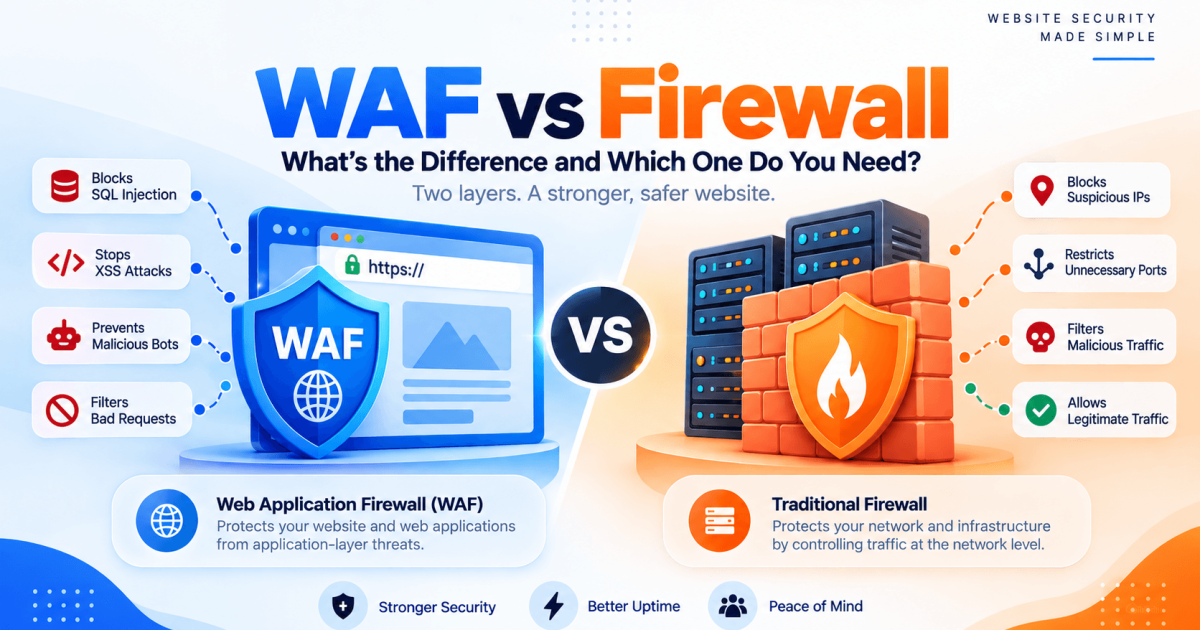
Although their names sound similar, they protect different layers of your infrastructure. A traditional firewall primarily controls network access, while a WAF focuses specifically on traffic reaching web applications.
So, when comparing a WAF vs firewall, which one does your website actually need?
In this guide, we’ll explain the difference between WAFs and traditional firewalls, what each protects against, when to use them, and why many websites benefit from using both.
What Is a Web Application Firewall (WAF)?
A Web Application Firewall (WAF) is a security solution designed specifically to protect web applications.
It sits between visitors and your website or application, monitoring incoming HTTP and HTTPS requests. When a request appears malicious, the WAF can block it before it reaches the application.
Think of a WAF as a security checkpoint specifically for web traffic. Instead of simply asking where traffic came from, it examines what the request is trying to do.
What Does a WAF Protect Against?
WAFs are designed to identify and mitigate common application-layer threats, including:
- SQL injection attacks
- Cross-site scripting (XSS)
- Directory traversal attempts
- Malicious file uploads
- Suspicious application-layer requests
- Certain brute-force and credential-stuffing patterns
For example, an attacker might send specially crafted input through a website form in an attempt to manipulate a database query. Because this request can arrive through legitimate HTTP/HTTPS ports, a traditional network firewall may allow the connection.
A properly configured WAF can inspect the request itself and block suspicious payloads before they reach the application.
When Should You Consider a WAF?
A WAF is particularly useful when your website or application:
- Accepts user input through forms
- Includes login or registration functionality
- Processes online transactions
- Uses APIs
- Stores or processes sensitive information
- Runs dynamic applications such as CMSs or e-commerce platforms
- Needs additional protection against common web application attacks
A WAF can also provide useful security logs, giving administrators greater visibility into suspicious requests and blocked attacks.
What Is a Traditional Firewall?
A traditional firewall, often called a network firewall, controls traffic entering and leaving a network.
Instead of deeply analyzing the contents of a web request, it typically makes decisions based on network-level information such as:
- IP addresses
- Ports
- Protocols
- Connection states
- Network security policies
For example, a firewall can allow web traffic through ports 80 and 443 while blocking unnecessary ports that should not be publicly accessible.
This reduces the network’s attack surface and prevents unauthorized connections to services that shouldn’t be exposed to the internet.
What Does a Firewall Protect Against?
A traditional firewall is useful for:
- Blocking unauthorized network connections
- Restricting access to specific ports and services
- Filtering traffic from unwanted IP addresses
- Controlling inbound and outbound network traffic
- Separating different network segments
- Protecting services beyond websites and web applications
For servers and hosting infrastructure, these controls are fundamental.
Where Does a Traditional Firewall Fall Short?
The main limitation becomes clear when malicious traffic uses an otherwise legitimate connection.
A website normally needs ports 80 and 443 open for HTTP and HTTPS traffic. A network firewall may therefore allow requests arriving through those ports.
But a malicious request can also arrive over HTTPS.
Unless the security system understands the application-layer content of that request, it may not recognize an SQL injection, XSS payload, or another web-specific attack.
That’s where a WAF adds another layer of protection.
WAF vs Firewall: Key Differences
The biggest difference between a WAF and a firewall is the type of traffic each is designed to inspect and protect.
| Feature | Web Application Firewall (WAF) | Traditional Firewall |
|---|---|---|
| Primary purpose | Protect web applications | Protect networks and infrastructure |
| Main traffic | HTTP/HTTPS | Broader network traffic |
| Protection layer | Application layer | Primarily network/transport layers |
| Examines | URLs, headers, parameters and request payloads | IPs, ports, protocols and connections |
| Common threats | SQL injection, XSS and web exploits | Unauthorized network access and unwanted connections |
| Best suited for | Websites, web apps and APIs | Servers, networks and infrastructure |
The two technologies aren’t direct replacements for each other.
A firewall determines whether a network connection should be permitted, while a WAF goes deeper into web traffic to determine whether an allowed web request appears safe.
WAF vs Firewall: A Simple Example
Suppose you run an e-commerce website.
Your network firewall allows HTTPS traffic through port 443 because customers need it to access your store.
An attacker then sends a malicious request through the same HTTPS connection, attempting to exploit a vulnerable input field.
From the network firewall’s perspective, the traffic may appear legitimate: it’s using an allowed port and protocol.
A WAF, however, can inspect the HTTP request and potentially identify the malicious pattern.
This example demonstrates why WAFs and traditional firewalls solve different security problems.
Do You Need a WAF, Firewall, or Both?
The right approach depends on what you’re protecting.
When a WAF May Be Particularly Important
Websites and applications with significant user interaction can benefit greatly from application-layer protection.
Examples include:
- E-commerce stores
- Membership websites
- Customer portals
- SaaS applications
- API-driven platforms
- Websites processing sensitive information
Because these systems rely heavily on dynamic requests and user input, they present a larger application-layer attack surface.
When a Traditional Firewall Is Essential
A firewall is a fundamental part of protecting server and network infrastructure.
It becomes particularly important when you need to:
- Limit publicly accessible ports
- Restrict administrative services
- Control network traffic
- Protect non-web services
- Segment infrastructure
- Reduce unauthorized access attempts
Even a simple website hosted on a server can benefit from properly configured network firewall rules.
When Should You Use Both?
For many production websites, using both is the stronger approach.
The firewall protects the network perimeter, while the WAF adds application-specific protection for web traffic.
This creates defense in depth. If one security layer doesn’t detect or stop a threat, another layer may still prevent it from reaching the application or underlying infrastructure.
WAF and Firewall Use Cases
Different websites have different security requirements. Here’s how the two technologies fit into several common scenarios.
E-Commerce Websites
Online stores handle customer accounts, forms, checkout requests, and potentially sensitive information.
A WAF can help detect malicious requests targeting the web application, while a network firewall restricts unnecessary access to the underlying infrastructure.
For an e-commerce environment, combining both technologies can provide more comprehensive protection.
SaaS Applications and APIs
SaaS platforms frequently process complex API requests and operate across multiple application components.
A WAF can inspect HTTP requests to application and API endpoints, while traditional firewalls can control network-level access between infrastructure components.
This layered approach is especially useful as an application’s architecture becomes more complex.
Small Business Websites
A smaller website may not require an overly complicated security architecture, but that doesn’t mean security should be ignored.
The appropriate setup depends on factors such as the site’s software, functionality, traffic, data sensitivity, and hosting environment.
Managed security features from a hosting provider can also reduce the amount of configuration website owners need to handle themselves.
How to Choose Between a WAF and Firewall
Rather than asking which technology is “better,” ask what types of threats and assets you need to protect.
1. Consider Your Website’s Functionality
A simple static website has different security requirements from an e-commerce platform or SaaS application.
The more your application relies on forms, logins, APIs, uploads, and dynamic requests, the more valuable application-layer inspection becomes.
2. Assess the Sensitivity of Your Data
Consider what would happen if your application or server were compromised.
Websites handling customer information, payment-related data, business records, or other sensitive information generally require stronger and more layered security controls.
3. Review Your Application Architecture
Modern applications often consist of multiple services, databases, APIs, and administrative interfaces.
A firewall can help control which systems can communicate, while a WAF focuses on requests reaching web-facing applications.
4. Consider Management Requirements
Security tools need ongoing maintenance.
WAF rules may require tuning to prevent legitimate requests from being blocked, while firewall rules should be reviewed as infrastructure and services change.
When choosing a hosting provider or security solution, consider:
- Who manages security rules?
- How frequently are rules updated?
- Are security logs available?
- How are false positives handled?
- Is technical support available when something goes wrong?
These operational factors can be just as important as the security technology itself.
How to Implement a WAF or Firewall
Deploying security tools is only the first step. Proper configuration and monitoring determine how effective they are.
Start With Appropriate Security Rules
Begin with rules that address common threats while matching your website’s actual traffic patterns.
Overly aggressive rules can block legitimate visitors, while overly permissive rules reduce the effectiveness of your protection.
Monitor Blocked Traffic
Regularly review security events to understand:
- What requests are being blocked
- Where suspicious traffic originates
- Which rules trigger most frequently
- Whether legitimate users are being affected
These insights help improve your security configuration over time.
Keep Rules Updated
Threats and application behavior change.
Review firewall policies as your infrastructure evolves and keep WAF rules updated to address emerging attack patterns and application changes.
Maintain Logs and Alerts
Security logs become particularly valuable when investigating suspicious activity.
Configure meaningful alerts for significant events rather than treating every blocked request as an emergency. This makes it easier to identify incidents that actually require attention.
Does a WAF or Firewall Slow Down Your Website?
Both technologies introduce some processing because traffic must be inspected before being allowed through.
However, the actual performance impact depends on factors such as:
- Number and complexity of security rules
- Traffic volume
- Deployment architecture
- Hardware or service capacity
- Depth of traffic inspection
A WAF generally performs deeper inspection than a traditional network firewall, so poorly optimized rules can introduce additional latency.
The goal is to balance security and performance through proper configuration rather than simply enabling as many rules as possible.
Reliability Matters Too
Security infrastructure should not become a single point of failure.
Production environments should consider redundancy and high-availability configurations so traffic can continue flowing if one security component fails or undergoes maintenance.
Backups are another important part of website security. While a WAF or firewall helps prevent attacks, backups provide a recovery path when data is corrupted, accidentally deleted, or otherwise lost.
Prevention and recovery should therefore be treated as complementary parts of a broader website security strategy.
WAF vs Firewall FAQs
Is a WAF the Same as a Firewall?
No. A WAF is a specialized type of firewall designed to inspect web application traffic, primarily HTTP and HTTPS requests.
A traditional network firewall protects the broader network by controlling traffic according to IP addresses, ports, protocols, and other network policies.
Is a WAF Enough to Protect a Website?
No single security control can protect against every threat.
A WAF can provide valuable protection against application-layer attacks, but it doesn’t replace network firewalls, secure application development, software updates, access controls, malware protection, backups, and other security practices.
Can I Use a WAF and Firewall Together?
Yes. In fact, they are commonly used together because they protect different layers.
A traditional firewall controls network-level access, while a WAF analyzes web requests for application-specific threats. Combining them creates a layered security model.
Which Is Better: WAF or Firewall?
Neither is universally better because they serve different purposes.
If your main concern is protecting a web application from malicious HTTP/HTTPS requests, a WAF provides specialized protection. If you need to control access to servers, ports, protocols, and other network resources, a traditional firewall is essential.
For many production environments, the best approach is to use both.
How Do I Know If I’ve Outgrown My Current Protection?
It may be time to review your security setup if your website has evolved significantly—for example, if you’ve introduced customer accounts, APIs, online transactions, sensitive data, new server services, or substantially higher traffic.
Changes in your application and infrastructure should trigger a review of whether your existing security controls still match your risk profile.
What Should I Ask My Hosting Provider About WAFs and Firewalls?
Before choosing a hosting plan or security service, ask:
- Is a WAF or network firewall included?
- Is protection enabled automatically or does it require configuration?
- Who manages and updates the security rules?
- Can custom rules be created?
- How are false positives handled?
- Are security logs and alerts available?
- What technical support is available during a security incident?
Clear answers to these questions will help you understand how much security management you’ll need to handle yourself.
Final Thoughts: WAF vs Firewall
The difference between a WAF and firewall comes down to what each protects.
A traditional firewall protects your network and infrastructure by controlling which connections are allowed. A WAF focuses specifically on your website or application, inspecting HTTP/HTTPS requests for potentially malicious behavior.
For most modern web environments, this shouldn’t necessarily be an either-or decision.
Using a firewall for network-level protection and a WAF for application-layer security creates a stronger defense-in-depth strategy.
If you’re choosing a hosting solution for a business website in Nepal, look beyond storage space and bandwidth. Consider how the provider approaches network security, application protection, backups, monitoring, and technical support.
With the right combination of hosting infrastructure and security controls, you can reduce unnecessary exposure while keeping your website fast, reliable, and available to your users.